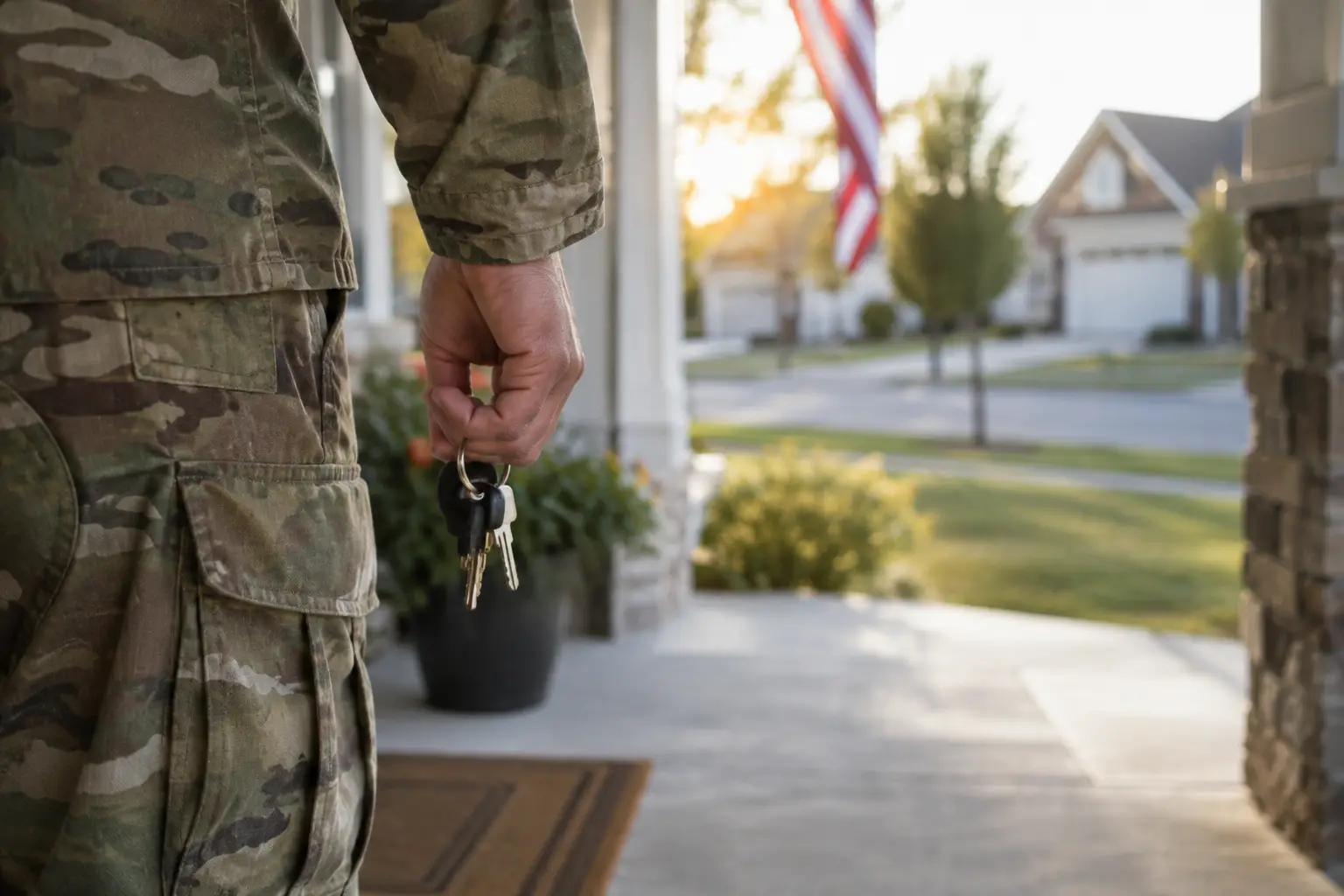
A military move rarely involves just a house. You may be balancing orders, a spouse’s job, school schedules and a property you already own. The VA home loan benefit can help, but it works best when you understand which decisions affect your cash and your next move.
The goal is not simply to buy with as little money down as possible. It is to buy a suitable home with a payment you can manage, while understanding what happens if your plans change.
Separate Your Benefit From Your Borrowing Capacity
A VA-backed purchase loan is generally made by a private lender, with the Department of Veterans Affairs guaranteeing part of the loan. That backing can allow eligible borrowers to purchase without a down payment and without monthly mortgage insurance.
It does not replace the lender’s review of your credit, income, debts and ability to repay. Eligibility for the benefit and qualification for a particular mortgage are separate questions.
Start with your Certificate of Eligibility, or COE. A lender can often help obtain it. The COE documents eligibility and provides information about entitlement and funding fee status. It is not a loan approval.
For active duty buyers, discuss expected changes in military pay and allowances. If separation or retirement is approaching, tell the lender early. Income that supports your household now may require different documentation if it will change before or shortly after closing.
Understand What Entitlement Actually Does
Entitlement is part of the VA’s guaranty framework, not a cash account or a personal spending limit. You do not withdraw it to make your down payment.
With full entitlement, VA does not impose a loan limit for a purchase without a down payment. You still must qualify with the lender, and the property must support the loan amount. Lender requirements also apply.
If some entitlement remains tied to an earlier VA loan, the calculation changes. Remaining entitlement and the applicable county loan limit can affect whether a down payment is needed for your next purchase.
That is why a friend’s experience is not a reliable guide. Two veterans buying similarly priced homes may face different cash requirements because one has full entitlement and the other still has a VA loan outstanding.
If You Already Own a Home With a VA Loan
You may be able to use remaining entitlement to buy another primary residence without selling the first home. However, the lender must evaluate both the entitlement calculation and your ability to carry the obligations.
If you intend to rent out the first home, do not assume the proposed rent will automatically offset its mortgage payment. Ask what lease, rental history, reserves or other documentation the lender requires.
The new purchase must meet VA occupancy requirements. VA purchase financing is generally for a primary residence, not a vacation home or an investment property. Military service can create special occupancy situations, including circumstances involving a spouse. Discuss your actual plans before choosing a closing date.
Reuse Is Possible, but Restoration Takes Attention
The VA benefit is not limited to one purchase. How you reuse it depends on what happened to the prior loan and property.
- Sell the property and pay off the VA loan: You can generally request restoration of the entitlement used for that loan.
- Pay off the loan but keep the property: A one-time restoration option may be available. Confirm the requirements before relying on it.
- Keep the property and its VA loan: You may have enough remaining entitlement for another eligible purchase.
- Have someone assume your VA loan: Do not assume your entitlement becomes available again. A release from liability and restoration of entitlement are separate matters.
An eligible veteran assuming a loan may be able to substitute their entitlement, subject to approval. Without an approved substitution, your entitlement can remain tied to that loan even after you sell.
Before coordinating a sale and purchase, have the lender review your COE, payoff information and restoration needs. An assumption or refinance out of a VA loan should not be treated as an automatic reset.
Compare the Funding Fee in Real Dollars
The VA funding fee is a one-time charge that applies to many VA loans. For purchase loans, the amount depends on factors including whether this is your first or a subsequent use of the benefit and whether you make a down payment.
Some borrowers are exempt. Exemptions include qualifying veterans receiving service-connected disability compensation and certain other eligible borrowers. Active duty recipients of the Purple Heart may also qualify. Have the lender verify your status rather than guessing.
If you owe the fee, you can generally pay it at closing or finance it into the loan. Financing preserves cash but increases the balance and the interest paid over time.
A down payment can reduce the funding fee at certain thresholds. Still, using savings just to lower the fee may leave you short on moving expenses, repairs or emergency reserves.
Ask for side-by-side estimates showing:
- No down payment with the funding fee financed.
- A down payment that changes the applicable fee.
- A comparable non-VA option, including any mortgage insurance.
Compare cash to close, monthly payment and remaining savings. No down payment does not mean no closing costs, and the smallest starting balance is not always the best household decision.
Treat the Appraisal and Inspection as Different Tools
The VA appraisal evaluates the property’s market value and whether it meets VA minimum property requirements. Those requirements address basic safety, soundness and sanitation.
An appraisal is not a home inspection. A separate inspection helps you understand the home’s condition and potential maintenance costs in greater detail.
If the appraisal identifies required repairs, the parties need a workable plan that satisfies loan requirements. Neither the buyer nor the seller should assume every repair can wait until after closing.
If value comes in below the contract price, options may include negotiating a lower price, requesting a reconsideration of value with supporting evidence, or paying the difference in cash. A higher value is not guaranteed.
The VA escape clause generally protects buyers from being forced to complete the purchase or forfeit earnest money solely because the price exceeds the VA-established reasonable value. It does not make every contract deadline or other obligation disappear. Review the language with your agent and lender.
Help the Seller See a Clear Path to Closing
A seller wants to understand price, proceeds, timing and the risk of a failed transaction. A VA offer is easier to evaluate when those details are clear.
Your offer should accurately describe any requested seller-paid costs. VA financing does not mean the seller must pay all of your closing expenses. Seller contributions are negotiable and subject to program rules.
A useful lender letter should reflect the review actually completed. Your agent can explain financing timelines, appraisal expectations and how you plan to handle any requested concessions. Avoid promises that underwriting or the property review cannot support.
You do not need to surrender sensible protections to demonstrate commitment. Clear documentation, realistic dates and prompt communication help reduce uncertainty without exposing your family to unnecessary risk.
Build Your Plan Before Spending Your Cash
Gather your COE, income documents, current mortgage statements and a realistic estimate of available savings. Write down whether you expect to sell, retain or rent an existing home, along with your anticipated move timeline.
Then ask for an entitlement review and a written comparison of your financing options. Reach out to Ed Parcaut, a U.S. Navy veteran and Modesto mortgage professional, NMLS 235384, to discuss how your VA benefit fits your budget, your property choice and your next move.